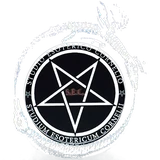
A serpent, or a dragon, curled upon itself until it grips its own tail in its jaws. The image strikes at once because it contains a paradox: the creature feeds on itself, destroying and regenerating itself in a single gesture. The ouroboros is one of the most universal symbols of Western esotericism and crosses millennia of history, from pharaonic Egypt to alchemical manuscripts and the psychology of the twentieth century.
The name and the image
The word comes from Greek and means, roughly, "the one who devours the tail". The image is simple, but its variants are many:
- a single serpent forming a perfect circle;
- a winged dragon, sometimes with legs, typical of alchemical codices;
- two creatures biting each other's tails, one winged and one wingless;
- a serpent divided into two halves of different colour, light and dark.
Each variant emphasises one aspect of the symbol: unity, the cycle, or the tension between two principles that eventually rejoin.
Egyptian origins
One of the oldest and most famous examples is found among the funerary objects of Tutankhamun, on one of the gilded shrines that enclosed the sarcophagus: a figure encircled by serpents biting their tails, connected to texts about the sun's night journey through the underworld. In that context the circular serpent protects and encloses the process of rebirth: the sun that dies in the evening and is reborn in the morning.
Here we already find the core of the meaning: there is no boundary between end and beginning, because what closes is also what starts again.
The ouroboros in alchemy
The symbol found its most celebrated home in Hellenistic alchemy. A Greek manuscript known as the Chrysopoeia of Cleopatra shows an ouroboros accompanied by the formula hen to pan, "the One is the All". It is one of the most powerful summaries of Hermetic thought: the prime matter and the philosophers' stone are the same substance at different stages, and the alchemical work is a cycle that starts from unity and returns to it.
For the alchemist the ouroboros represented three ideas:
- Circulation: repeated distillations, in which vapour rises, condenses and falls back, were seen as a serpent turning back on itself.
- The self-sufficiency of the work: everything needed is already contained in the matter; nothing is added from outside.
- Death that generates life: devouring is a form of transformation, not annihilation.
Cycle, eternity, totality
In general symbolism the ouroboros is used to express concepts that language struggles to hold:
- eternity, understood not as infinite time in a straight line but as time that returns;
- the cyclical nature of the world: seasons, phases of the moon, birth and death;
- the unity of opposites: head and tail, beginning and end, creation and destruction are parts of a single body.
Similar figures are found in other cultures. In Norse mythology the serpent Jörmungandr encircles the world biting its own tail, and in several traditions the circular serpent marks the boundary of the ordered cosmos, separating it from chaos.
A psychological reading
In the twentieth century analytical psychology read the ouroboros as an archetypal image of the original state of the psyche, an undifferentiated totality preceding the distinction between consciousness and the unconscious. It is an interesting key because it shows that the symbol belongs not only to the history of ideas but also to anyone's inner experience.
A concrete example: many personal journeys seem to keep returning to the same point, the same mistakes, the same questions. The ouroboros invites you to see this return not as failure but as a spiral which, at each turn, can be lived with greater awareness.
The ouroboros on the Studio's path
In the view of Studio Esoterico Cornelio the ouroboros is a symbol of spiritual maturity. It teaches that growth does not consist in fleeing from what you are but in transforming it from within: the tail the serpent bites is part of its own body. What is consumed is not lost; it is reabsorbed and becomes nourishment.
For those who wish to work with this symbol, a few simple practices:
- draw it by hand, slowly, closing the circle with care at the point where mouth and tail meet;
- use it as an image for reflection at the end of a cycle in your life, to recognise what is closing and what is being prepared;
- observe natural cycles, such as the turning of the seasons, looking for the same movement in them.
In short
- The ouroboros is the serpent or dragon biting its own tail and forming a circle.
- It already appears in ancient Egypt, linked to the sun's cycle of death and rebirth.
- In Hellenistic alchemy it expresses the idea that "the One is the All" and the circular nature of the work.
- It symbolises cyclical eternity, the unity of opposites and continuous transformation.
- On the inner level it invites you to transform yourself rather than flee from yourself.