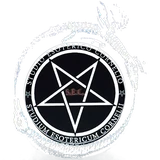
In a great many ritual traditions the first gesture is to trace a circle. With chalk on the floor, with salt, with a cord, with the point of a sword in the air or simply with the gaze and the hand. The magic circle is one of the most recognisable images of the Western esoteric tradition, but its meaning is much older and more universal than ceremonial magic: it comes from the human need to separate a sacred space from ordinary space.
Why a circle
The circle is the simplest and most perfect geometric shape. Every point on its edge is the same distance from the centre; it has no beginning or end; it encloses the greatest area with the smallest perimeter. For this reason it has been associated with:
- totality, because it contains everything within it;
- eternity, because it has no starting or finishing point;
- protection, because it creates a continuous boundary with no gaps;
- the centre, because every circle exists in relation to a central point.
Sacred space in ancient cultures
The idea of marking off a sacred place is common to many civilisations. The Greeks called the sacred enclosure around a temple the temenos, a space "cut off" from common use. In Roman tradition, according to the story of Romulus, the founding of the city was marked by a furrow traced with a plough, a sacred boundary that was not to be violated.
In all these cases the boundary does not only close off: it qualifies. What lies inside the circle belongs to a different order.
The circle in ceremonial magic
In medieval and Renaissance grimoires, such as the Key of Solomon, the circle is described with great precision. It is traced with a consecrated tool, often double or triple, with sacred names written between one ring and the next and symbols placed at the four cardinal points. The practitioner works inside the circle, which represents a place of order and protection.
In modern forms of the ceremonial tradition and in neopagan currents, the construction of the circle generally follows a few stages:
- purification of the space, with water, salt or incense;
- tracing the circle, usually clockwise, starting from the east;
- acknowledging the four cardinal directions, each associated with an element;
- ritual work at the centre;
- closing, retracing the circle in the opposite direction to dissolve the boundary.
The last step is as important as the first: in symbolic logic, what is opened must be closed with the same care.
The cardinal directions and the elements
A very common correspondence in the modern Western tradition associates the four cardinal directions with the four elements:
| Direction | Element | Meaning |
|---|---|---|
| East | air | beginning, rising light, thought |
| South | fire | fullness, energy, will |
| West | water | feeling, sunset, introspection |
| North | earth | stability, night, rootedness |
Other traditions use different correspondences, and this is a good example of how symbolic systems vary. What matters is consistency within the chosen practice.
The circle without ritual
The circle does not belong only to magic. Many peoples sit in a circle at their assemblies, dance in a circle at folk festivals, gather in a circle to pray or to tell stories. In all these cases the circle creates equality: no one is at the head, everyone is the same distance from the centre.
The Studio's reading
For Studio Esoterico Cornelio the magic circle is above all an image of attention. Tracing a circle means saying: in this space and at this time I am present, not scattered. The outer boundary is the sign of an inner boundary that leaves distractions outside and welcomes what you want to cultivate.
A simple exercise, suitable for anyone:
- before meditating or reading an important text, sit in the middle of a room;
- imagine tracing a circle of light around yourself, slowly, clockwise;
- stay for a few minutes in the silence of that space;
- at the end, imagine dissolving it with the same movement in the opposite direction.
In short
- The circle is a symbol of totality, eternity, protection and centre.
- Marking off sacred space is common to many cultures, as the Greek temenos shows.
- In ceremonial magic the circle is traced with care, with names and symbols at the cardinal points.
- The four cardinal directions are often associated with the four elements, with variations between traditions.
- On the inner level the circle represents gathered attention and presence.